Side · Year-round
Skinny focaccia with rosemary and sea salt
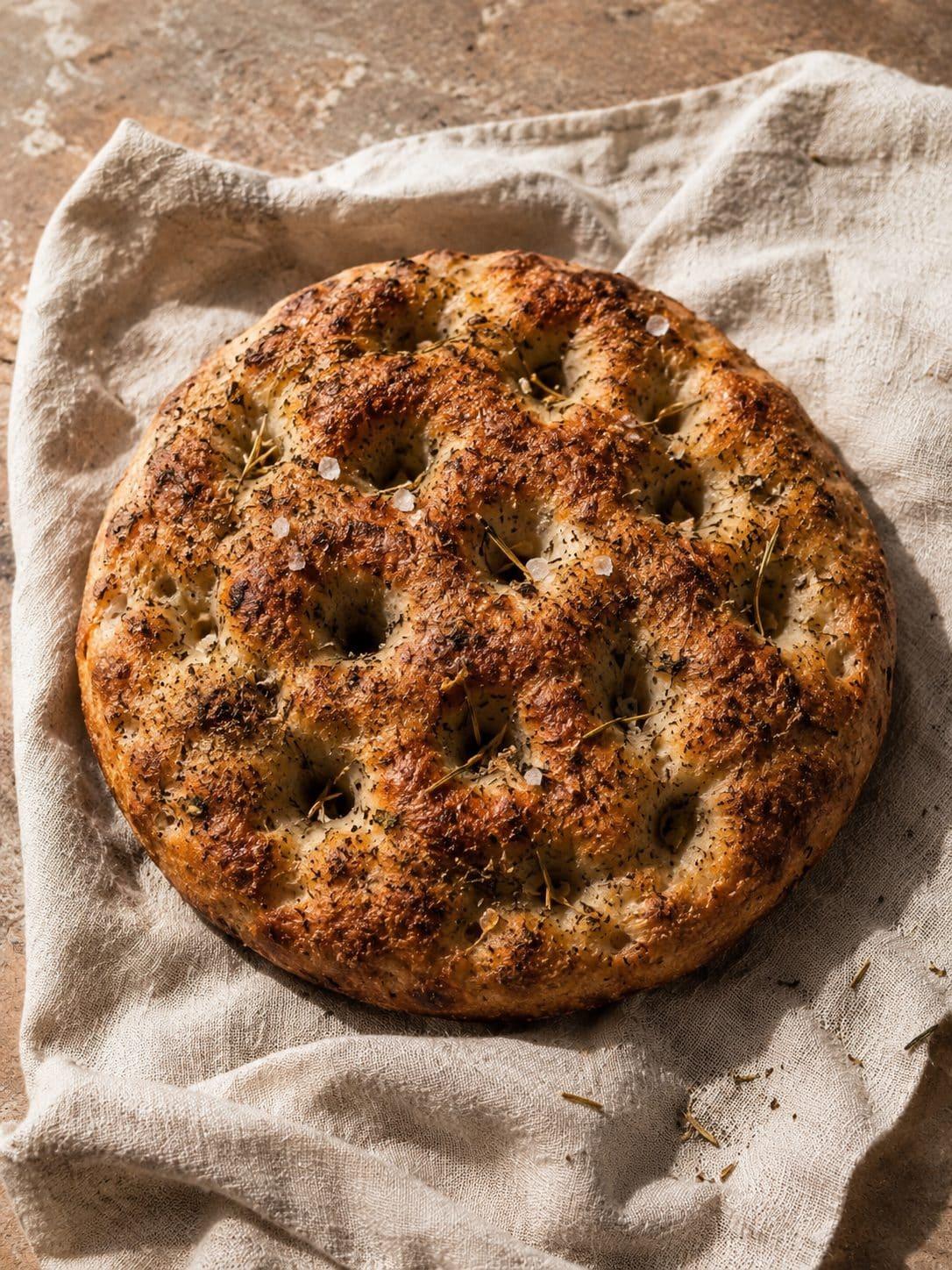
Airy inside, crackling outside, all its flavour kneaded in. The lean one nobody believes is lean.
I learned to love bread in a kitchen in Veendam, up in Groningen, at a friend's house. His mother, Angela, was a cook who taught kids how to cook, and she more or less adopted me into it. She made focaccia constantly, herbs pulled straight from her own garden, still smelling of dirt and sun. Fantastic. The kind of taste that ruins you for the supermarket version forever. I have been baking my own bread ever since.
But real focaccia, the old way, is basically a delivery system for olive oil. They drown it. Pools sitting in the dimples, running down your wrist. Glorious, but you cannot feed people like that every night on the coast. Not villa guests who want bread on the table and still want to fit into what they bought for dinner. So I stripped it back. The oil that used to sit on top in a puddle goes into the dough now. Ten grams. The herbs do the rest, the way Angela's garden did. Oregano, basil, thyme, rosemary, garlic, all kneaded straight in, a heavy hand of black pepper.
The flour does what is left. Harina de fuerza, the strong stuff in the black bag from the Spanish supermarket, the one that costs almost nothing and behaves like it costs ten times more. It drinks the water and gives you the open crumb, the holes, the chew. Let the flour and water get to know each other before the yeast turns up. Do not rush the rise. Wet fingers for the dimples. And when it comes out golden and crackling and smelling of a garden, nobody at the table believes it is the lean one. Angela would have approved.
- Total time
- 1 h 5 min
- Serves
- 8 people
- Difficulty
- 2 / 5
- Pair with
- A bowl of good olive oil for dipping and a glass of cheap, honest red. Nothing fancy. The bread is the star.
Ingredients
Dough
- 500 gharina de fuerza (strong bread flour) · the black bag from the Spanish supermarket
- 375 glukewarm water
- 7 gdry yeast
- 1 tsphoney
- 50 mllukewarm water, for the yeast
- 10 gsalt
- 10 golive oil
Herbs in the dough
- 2 tspdried oregano
- 1 tspdried basil
- 1 tspdried thyme
- 1 tspdried rosemary
- 1 tspgarlic powder
- to tasteblack pepper
To finish
- 5 golive oil
- a few sprigsfresh rosemary
- a pinchoregano
- to tastecoarse sea salt
Method
- 1
Mix the 500 g flour with 375 g lukewarm water. Stir to a rough, shaggy dough. Cover and rest 30 to 60 minutes. This is the flour drinking. Do not skip it.
- 2
Stir 7 g dry yeast into 50 ml lukewarm water with 1 tsp honey. Leave 5 to 10 minutes until it foams and smells like beer. If nothing happens, the yeast is dead. Start again.
- 3
Add the yeast to the dough and knead 3 to 4 minutes, until it is one thing and not two.
- 4
Add 10 g salt, the oregano, basil, thyme, rosemary, garlic powder and a heavy hand of black pepper. Knead 5 minutes more. This is where the bread gets its soul.
- 5
Work in 10 g olive oil and keep kneading until the dough turns smooth and elastic and stops fighting you.
- 6
Cover and let it rise 1.5 to 2 hours, until doubled in volume.
- 7
Tip the dough onto a tray lined with baking paper. Press and stretch it gently to fill the tray. Gently. You spent hours building those bubbles.
- 8
Leave it another 30 minutes to relax and puff back up.
- 9
Wet your fingers and drive them into the dough, all the way down. Those craters are the signature.
- 10
Brush with 5 g olive oil and scatter fresh rosemary, a little oregano and coarse sea salt.
- 11
Bake 20 to 25 minutes at 220 °C until golden and cooked through. Eat it warm, the day you make it.